
Hello everybody, welcome to part two of this three-part post on the most famous Rogue Wave encounters in modern history. As promised this post will dive into the SS Michelangelo and her brush with a Rogue Wave. I hope you enjoyed the last post and if you haven’t read part one, please go back here and check it out before beginning part two.
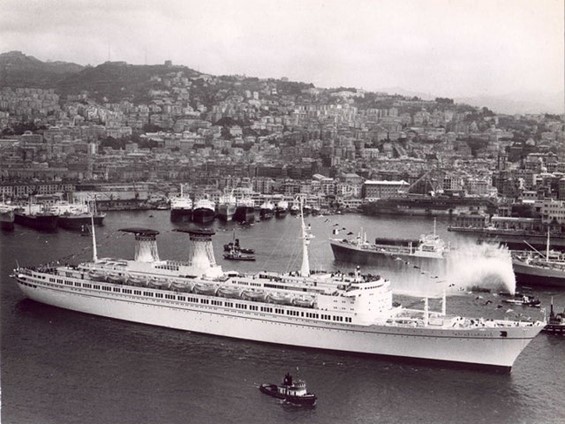
The SS Michelangelo was one of the last purpose-built ocean liners ever built. Ordered by the Italian Line she and her sister SS Raffaello were launched in the early 1960s. By this point, jet travel was quickly gaining traction as a better alternative to transatlantic sailing. She would go on to have a short career being withdrawn from passenger service in 1975. However, in her short career she would undoubtedly have one of the most terrifying encounters at sea a ship can have.
In 1966, only a year into her career, Michelangelo was on a crossing from Genoa to New York. Five days into this journey she hit a storm. This storm saw waves reaching 66 feet high which battered the ship, twice the height of the waves the Lusitania had dealt with in part 1. However, Michelangelo was a larger and much newer ship, so she was in no real danger. Despite this, as the storm was severe, the captain ordered the ship to turn sideways to the waves to avoid damage to the bow or forward superstructure. Additionally, all passengers in forward cabins were moved to interior spaces as a precaution. Then after a brief diversion to help a freighter who was taking on water who then claimed to have the situation under control, the storm started to wane. The captain then decided to allow passengers back into the forward sections of the ship and turn the ship back into the waves to continue her course. However, almost as soon as the ship’s course was set, Michelangelo fell into a deep trough and like the Lusitania was then pummeled by a giant wave.
After the wave had passed along her length, the ship’s crew began assessing the damage. The forward superstructure and bridge were caved in by the force of the wave. The ship was ultimately ok to continue sailing but unfortunately, the true damage came at the cost of the passengers and crew. Two passengers and one crewman in the forward cabins of the superstructure that had been pushed in by the wave were killed and a further 50 were injured from the collision. Michelangelo continued her journey and eventually met up with a Coast Guard ship to assist the injured passengers. After this journey, her forward superstructure would be repaired with steel instead of the previous aluminum for strength and she would suffer no further major incidents for the rest of her career. For a more detailed analysis of this incident and the story of SS Michelangelo check out this video from Big Old Boats which was a big help in making this article:
Finally, while this incident was tragic and Lusitania’s was almost so, things could have been much worse if one thing was different. See both the Lusitania and Michelangelo hit the Rogue waves head-on, but what if the wave struck the side of the ship? Find out in part three what happens to a massive liner when a monstrous wall of water strikes her broadside.
Thanks for reading and if you enjoy this post, please feel free to leave a comment. A big thanks to Ocean Liner Designs and Big Old Boats for the information and inspiration needed to create these posts, definitely check out their channels if you like this type of content. Look forward to the end of the story in part 3!
 Fish's Facts
Leave a comment