
Hello everybody, welcome to part two of this three-part post on the USS Nevada. As promised this post will dive into Nevada’s WW2 service. I hope you enjoyed the last post and if you haven’t read part one, please go back here and read before beginning part two.
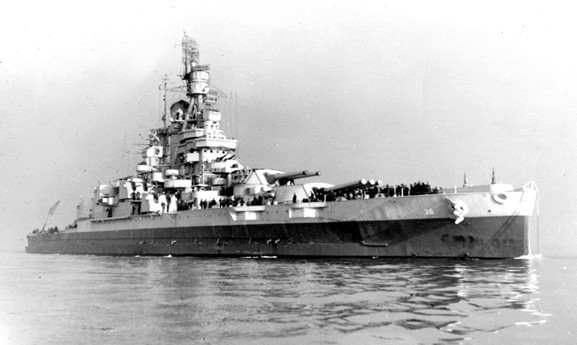
As the second world war was beginning to rage around the world in the late 1930s, things were looking ever grimmer for the then-neutral United States. As tensions rose and the ever-growing threat of the Imperial Japanese Navy loomed in the Pacific, then President Franklin D. Roosevelt ordered the US Pacific Fleet moved to Pearl Harbor, Hawaii in a show of force against the Japanese. What FDR couldn’t have known though was just how the Japanese would respond.
On the morning of December 7, 1941, USS Nevada sat moored at the end of a line of battleships on Ford Island in the middle of Pearl Harbor. She sat a notable distance from the seven other battleships at Pearl Harbor and as the eldest of the eight battleships present, she would soon show what a good big sister she was. At 7:55 am local time the Japanese began their surprise air attack on Pearl Harbor with the Nevada being the first ship hit in the conflict by a torpedo bomber. She righted herself by cross-flooding the damaged side and would then be the first ship to return fire and down an enemy aircraft. Nevada would then become the only one of the eight present battleships to get underway during the attack. In the second wave of the attack, she would be hit by five 250 kg bombs. Despite both being on fire and flooding the Nevada would move to rescue sailors from the crippled USS Arizona before intentionally beaching itself at Hospital Point to prevent Japanese ships or subs from entering the harbor.
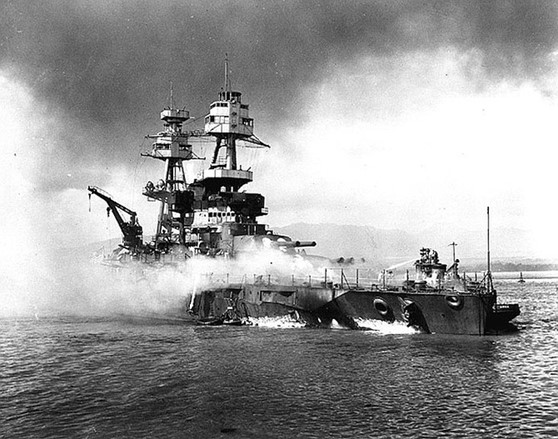
After the attack, Nevada sat heavily damaged where she was beached on Hospital Point. She had lost 60 of her crew in the attack, but she wouldn’t let their sacrifices be in vain. She was raised and sent to a shipyard for repairs and refits. Among these repairs were major upgrades to her anti-aircraft guns ensuring that she would never be an easy bombing target ever again. Then with her repairs complete, she reentered service in May 1943 on convoy duty. However, greater duty was on the horizon when in she was chosen to become one of the battleships to provide shore bombardment support during the D-Day landings. This made Nevada the only battleship to fight in both Peral Harbor and D-Day. Nevada would continue bombardment duties in Europe until she would have to be sent back to New York because she had worn out her turret barrels. She would rather ceremoniously be refitted with USS Arizona’s barrels, in a way allowing her lost sister to continue the fight.
After receiving these new gun barrels, Nevada headed to the pacific theater to aid in the Battle of Iwo Jima and the Invasion of Okinawa. During the Invasion of Okinawa she would be attacked by seven kamikaze’s one of which hit her number three turret killing 13 of her crew and disabling the turret. She would continue to provide bombardment support until the end of the war where she was stationed within range of the Japanese mainland for the planned bombardment of Japanese military and factory locations. This bombardment was planned in preparation for the allied invasion of Japan before the use of nuclear weapons was decided upon. Thus, with the war over and the age of the dreadnought long over, USS Nevada was decommissioned in August of 1946. However, she would still find a way to serve her country one final time.
Thanks for reading and if you enjoy this post please feel free to leave a comment. A big thanks to Dark Seas and National Geographic for the help and inspiration to create these posts. Look forward to the end of the story in part 3!
 Fish's Facts
Leave a comment