
Welcome back everyone to a new three-part blog post on one of America’s toughest Battleships ever made, the USS Nevada. This first post will go over the ship’s creations and WW1 service. The second post will go through Nevada’s WW2 service from Pearl Harbor to Normandy. Finally, part three will go through Nevada’s decommissioning and destruction in the Bikini Atoll Nuclear Experiments.
At the turn of the 20th century, a new arms race was about to begin. Decades before the aircraft carrier would cement itself as the dominant player in naval warfare, the centuries-old motto of “bigger boats with bigger guns” was about to escalate at a furious pace. In 1906 Britain would launch the HMS Dreadnought, a new type of battleship synonymous with massive primary and secondary guns and steam turbine propulsion. This new battleship was faster and more powerful than anything that had come before it and Britain was confident that their new ship would continue to ensure that Britannia ruled the waves. Little did they know that their new ship would be the spark to light a new age of battleships that would become known as dreadnoughts.
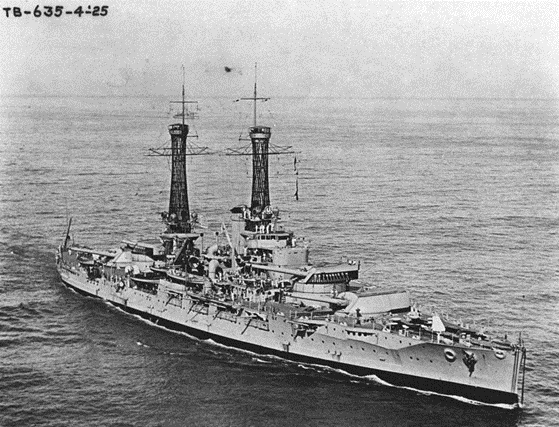
USS Nevada (BB-36) would be built amid this dreadnought mania. Launched on July 11, 1914, she would be the first of the Nevada Class battleships along with her sister USS Oklahoma. She would be the first ship in the US Navy to have triple 14-inch gun turrets, a single funnel, and an oil-burning boiler over conventional coal. She was a force to be reckoned with and come March of 1916 she was fully operational and ready for duty.
Unfortunately, due to an oil shortage, Nevada spent the first two years of her life patrolling the eastern seaboard down to the Caribbean. This would cause her to become the last American warship to be sent to Europe during the first world war in August of 1918. Once overseas she would spend the remainder of the conflict on escort missions and general duties. Despite this rather unimpressive deployment Nevada would get to be one of nine other battleships that escorted US President Woodrow Wilson to Europe for the Paris Peace Talks. This ended her WW1 service, and she returned to the States for the interwar years. Though she would see no conflict during this time she would travel to other countries such as Brazil and Australia on military duties. Finally, the most important thing to note during the interwar period was the upgrades and modifications she received. These included tripod masts, anti-torpedo bulges, gear turbines, aircraft catapults, a new superstructure, and 5-inch anti-aircraft guns. All this would leave Nevada as a strong fighting force even into the 1940s where her next great calling was soon to come, but that’s a story for next time.
Thanks for reading and if you enjoy this post please feel free to leave a comment. A big thanks to Dark Seas and National Geographic for the help and inspiration to create these posts. Look forward to part 2 soon!
 Fish's Facts
Leave a comment