
Please read Part 1 of this post before continuing, Thanks!
For most of 1914, Britannic sat slowly proceeding at a snail’s pace while the first world war drastically slowed her construction. See while most large liners like Olympic and Cunard’s Mauritania had agreements with the British Admiralty to be used for military service should the need arise. It was determined early in the war that these mega liners were too large and costly for effective military service, which is why they remained in commercial operations in the early months of the conflict. Olympic even returned to the Harland and Wolfe shipyard hoping to wait out the conflict next to her sister Britannic as seen below.
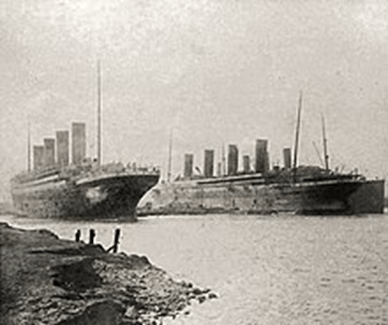
This notion changed, however, with the war’s quick escalation. The British Admiralty decided that larger ships would be necessary for the war effort. White Star Line was then informed that when the Admiralty gives the word, Britannic would need to be ready for service within four weeks of notice. This lit a fire at the Harland and Wolfe shipyard to finish Britannic’s construction, but only a few weeks later from receiving this notice a major development in the war would turn that fire into an inferno. On May 7, 1915, the RMS Lusitania was torpedoed by U-20 off the coast of Ireland and sunk in 18 minutes killing 1,195. This event would cause a massive escalation in the war and would ultimately be a major reason for the US’s future involvement in the war. Most importantly for Britannic, however, was that the sinking of the Lusitania became the catalyst for a no-holds-bar, win-at-all-costs mentality for the British Admiralty.
Britannic’s construction was finally completed in November of 1915, and no sooner was she finished was she pulled into the navy and made a hospital ship officially becoming HMHS Britannic (His Majesties Hospital Ship). She was painted white with a green strip along her center with intermittent red crosses. Her masts and funnels were also painted yellow as well. This was done to make Britannic as visible as possible. This may seem counterintuitive but based on the Geneva Convention a marked hospital ship cannot be fired upon by any side. Thus, with this paint scheme, Britannic was theoretically protected from all enemy and U-Boat attacks.
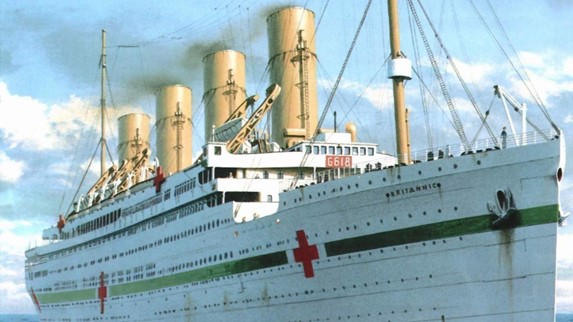
Britannic would go on to serve as a hospital ship until March of 1916 when the British Admiralty informed the White Star Line that her services would no longer be required. This was cause for celebration for the Line as their prized ship had returned unscathed and was ready to be refit for passenger service. A happy ending…if only. A few months into her conversion back to passenger service, the British Admiralty rescinded their decision and informed White Star that Britannic would be needed as a hospital ship again. So, on August 26, 1916, Britannic sailed to the Mediterranean to assist in the war effort yet again. That would be until November 21, 1916.
On November 12, 1916, Britannic was ordered to head to the island of Lemnos, Greece from Southampton to pick up and bring home more wounded soldiers like she had done times before. Unfortunately for Britannic, she would never reach Lemnos. On the morning of November 21, 1916, Britannic was sailing between the islands of Makronisos and Kea in the Kea Channel. However, one-month earlier U-73 had laid mines in this channel undenounced to the allies or the crew of the Britannic. Then, at 8:12 am on the 21st of November, Britannic struck one of these mines on her starboard side and was rocked by the powerful shockwaves of the explosion. The mine was so powerful in fact that it lifted Britannic slightly out of the water, warped her hull, and snapped her receiving telegraph cable. She then began quickly taking on water with her first 4 and compartment 6 breached. Survivable damage, but the ships warping had jammed the watertight door rails from closing between compartments 6 and 5 leading to its flooding as well.
At this point, we know that six of Britannic compartments are flooded, but she was designed to survive this level of flooding. She will stay afloat if no more flooding occurs. So why did she continue to sink? Unfortunately for the ship, the nurses aboard had opened many of the bow portholes that morning for circulation and once the first six compartments were flooded, the bow was low enough for water to enter through these port holes, and her fate was sealed. The captain ordered her engines forward in hopes of beaching the ship on the island of Kea only a few miles away, but this decision would prove deadly. It may have worked if not for another bit of damage inflicted by the mine. Britannic’s steering gear was jammed by the force of the mine leaving her unable to steer and thus unable to turn toward Kea. The captain did, however, attempt to steer the ship by shutting down her starboard propeller leaving the ship to slowly be pushed towards Kea.
Unfortunately, despite the captains’ orders to not launch the lifeboats while the ship was in motion, these orders were not adhered to. Four lifeboats would be launched from Britannic’s port side before the captain gave the authorization to lower lifeboats. One would sail away without incident but two would be sucked into Britannic’s spinning port propeller chopping up the boats and killing most aboard them. The fourth lifeboat nearly met the same fate as the other two, but the captain ordered the engines shut down just before this lifeboat reached the propeller. Finally, after the engines were shut down the captain ordered the lifeboats to be lowered away and despite one final push of Britannic’s engines to get the ship to Kea, the ship sank at 9:07 am leaving 30 dead and RMS Olympic as the only remaining Olympic Class ship.
Thanks for reading and I hope you enjoyed this second and last part of this series on Titanic’s Sisters. Once again a big thanks to Ocean Liner Designs, Historic Travels, and Big Old Boats on YouTube for inspiration on these posts, please check them out if you get a chance. As always feel free to leave any comments or questions below and have a wonderful day!
 Fish's Facts
Leave a comment