
Welcome back to a new two-part post! As promised, this is the last part of the two-part series promised last week on Titanic’s two sisters Olympic and Britannic. I hope you enjoyed the first two-part posts on Olympic and if you haven’t read them yet see Part 1 and Part 2 here before continuing. Like last time, the first post in this two-part synopsis of Britannic will focus on her planning, construction, and ambitions for the future. The second post will focus on Britannic’s war service and sinking. Enjoy!

At the start of 1912, I believe anybody would have been hard-pressed to say things were going poorly for the White Star Line. Sure, Olympics’ recent collision with HMS Hawke was a setback for the company, but she was repaired and sailing once more. White Star once again had the largest and most luxurious ship on the Atlantic. Additionally, her newest sister Titanic was completing her fitting-out process and would soon be ready for her maiden voyage in April. The icing on the cake, however, was that the last and largest of the Olympic class ships, Britannic, was beginning construction and soon White Star Line would have the three largest ships in the world dominating the Transatlantic market. Little could they have known what tragedies and terrible luck lay just around the corner.
The story of Britannic begins on November 30, 1911, when her keel was laid down in the same slipway that her sister Olympic had previously occupied. She was to be the third and last ship for White Star Line’s Olympic class of vessels. See White Start had ordered the Olympic Class from Harland and Wolfe Shipyard for one main reason, the Cunard Line. For years Cunard and White Star tried to outdo one another often in the fight for the Blue Riband which was gifted to the ship that could make the fastest crossing from England to New York. Unfortunately for White Star, Cunard often won. This was the case at the start of 1909 when Cunard’s Mauretania held the Riband and the title of the world’s largest ship. Moreover, her sisters Lusitania and Aquitania were also nearly as fast and large. Yes Cunard was certainly a dominating force at the start of the 1900s, so what was White Star to do? Well, they knew competing on speed was almost impossible both mechanically and economically, but if they couldn’t beat Cunard’s speed, they’d beat their size. So, the Olympic Class Liners were designed and ordered. Olympic, Titanic, and Britannic each to be larger and more luxurious than the last, and Britannic would be the largest and most elegant of them all. With this, White Star would soon be able to rival Cunard’s big three and possibly become the dominant Line on the Atlantic, right?
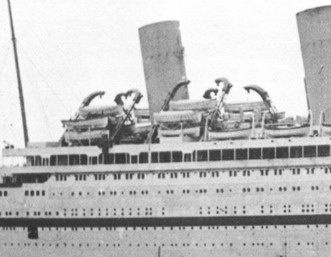
Now with that knowledge let’s jump forward to April 1912. Britannic is still in the early phases of her construction when news of her sister’s Titanic’s tragic sinking during her maiden voyage reaches Harland and Wolfe. This tragedy ultimately led to a delay in Britannic’s construction as her builders set to work modifying her design and enhancing her safety feature to ensure that if Britannic were to ever suffer the same level of damage as Titanic she would survive. These modifications included a double hull along not just her belly but up along her sides where the engines and boiler rooms would be. Secondly, they increased the width of the ship to accommodate the double hull and raised sections of her watertight bulkheads from E to B deck to make spillovers less likely. These changes would allow Britannic to stay afloat with her first six watertight compartments flooded without sinking. The exact amount of damage sustained by Titanic, but this would not be her most visible modification. Now for those who have seen the movie Titanic, you may remember that when lowering the lifeboats, they were suspended on small metal cranes called davits and that these davits were manually operated. However, with the new lifeboat regulations Britannic was given massive electric davits that towered on the ship as seen below. These davits would allow Britannic to not only hold more lifeboats but to launch them far quicker which would end up being crucial in the future.
Finally, with the revisions to her design made, Britannic resumed construction and was launched on February 26, 1914, to begin her fitting-out process. She was on her way to a long and successful career alongside her sister Olympic. Unfortunately for her, the world was changing fast and by August WW1 had begun. The British Admiralty ordered an immediate cease of all nonmilitary construction, and the Britannic was delayed for a second time, but she would not stay like this for long.
This ends part 1, Thank you so much for reading! If you liked that post please feel free to leave a comment or question below. A big thanks Historic Travels for the inspiration to write this post and his amazing videos on all three Olympic class ships. Please check out his YouTube channel if you like this type of content and I’ll see you soon for part 2!
 Fish's Facts
Leave a comment